Jakarta – AswinNews.com —
The year 2026 opened with a series of shocking global geopolitical developments, ranging from political turmoil in the United States to the emergence of an international forum known as the Board of Peace in Davos, which has been claimed as an alternative to the United Nations.
The forum has drawn sharp criticism for excluding Palestine from discussions about peace in its own territory.
Amid this controversy, Indonesia officially joined the Board of Peace as one of seven supporting Muslim countries, with a membership fee obligation of Rp16.9 trillion.
This decision has raised serious questions regarding the direction of Indonesia’s foreign policy: is it a strategic diplomatic move, or does it blur Indonesia’s long-standing stance in support of the Palestinian cause?
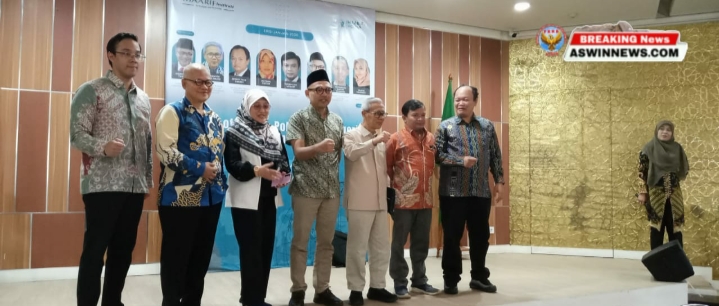
In response to these issues, MA’ARIF Institute held a talk show entitled “Board of Peace: Foreign Policy and the Fate of Gaza”, at Menara Tanwir, 6th Floor of the Muhammadiyah Central Board Building, Menteng, Central Jakarta, on Wednesday (28/01).

The discussion featured several prominent speakers, including Ahmad Fuad Fanani (Senior Expert Staff at the Indonesian Presidential Staff Office), Hajriyanto Thohari (Indonesian Ambassador to Lebanon 2019–2025),
Hasibullah Satrawi (Global Islamic Politics Observer), Sudarnoto Abdul Hakim (Chairman of the Indonesian Ulema Council for Foreign Affairs and International Cooperation), M. Waffaa Kharisma (Researcher at the CSIS Department of International Relations),
Andar Nubowo (Executive Director of MA’ARIF Institute), and Mutiara Pertiwi (Lecturer of International Relations at UIN Jakarta).
The discussion was moderated by Ramita Paraswati, a researcher at MA’ARIF Institute.
The talk show was opened by Andar Nubowo, Executive Director of MA’ARIF Institute, who critically highlighted Indonesia’s participation in the Board of Peace, which he viewed as aligned with the interests of U.S. President Donald Trump.
“This extraordinary discussion examines the Board of Peace recently signed by our President.
It becomes an important note because the fate of Palestine remains unclear, while conflict and killings continue in Gaza. Indonesia appears to be prioritizing political and economic interests.
This could represent a new form of colonialism,” Andar stated.
He emphasized that humanitarian values and resistance to occupation are extremely crucial and sensitive issues.
“How to fight for Palestinian independence and the future peace of Gaza remains a major question.
The Palestinian–Israeli conflict is seemingly being addressed through Trump’s version of a peace council, revealing that political and economic projects are being placed above genuine world peace,” he asserted.
Meanwhile, Ahmad Fuad Fanani, Senior Expert Staff to the President, explained that the President’s policy should be viewed comprehensively and from a long-term perspective, as the Gaza issue is not a conflict that can be resolved overnight.
“The President wants to demonstrate that Indonesia is struggling from within the global system.
At the UN General Assembly on September 23, 2025,
President Prabowo Subianto expressed Indonesia’s readiness to deploy 20,000 peacekeeping troops to Gaza and other conflict areas. This is a concrete, step-by-step effort, not merely wishful thinking,” he explained.
Ahmad Fuad Fanani also linked this policy to Indonesia’s long history of an independent and active foreign policy, starting from President Soekarno’s initiation of the 1955 Asian-African Conference, Indonesia’s role in the Non-Aligned Movement and ASEAN under President Soeharto, to Indonesia’s continued support for Palestine since 1988.
“Indonesia is not a spectator, but an active player.
Through the United Nations, humanitarian assistance, and security monitoring, Indonesia’s contributions continue.
Evidence shows that the suffering of the Palestinian people has decreased compared to conditions in 2025,” he concluded.
🖊️ Journalist Report: Ine
✍️ Editor: Abah Roy | AswinNews.com Editorial Desk – Sharp, Trusted, Balanced, and Up-to-Date