By: Ine – Jakarta Bureau Chief
Editor: Kenzo | AswinNews.com – Sharp, Accurate, Balanced, Trusted
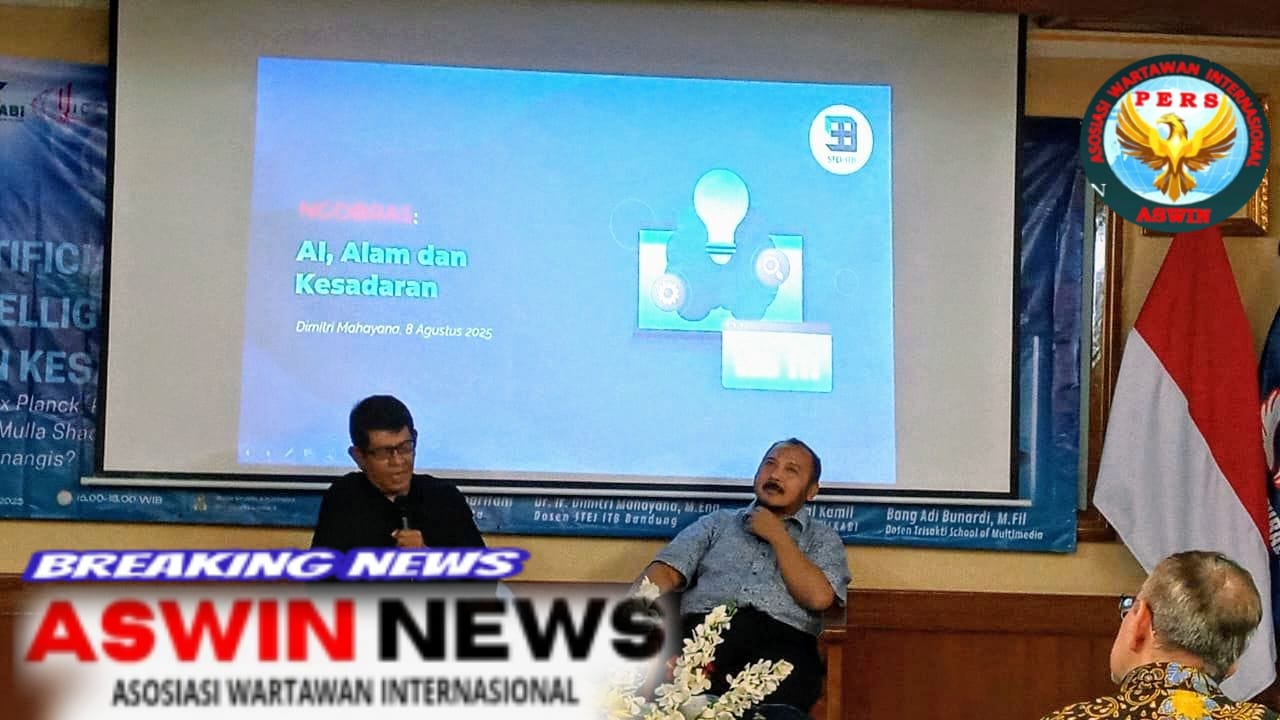
Jakarta – AswinNews.com — Is consciousness merely the product of computational processes, or is there a deeper, undiscovered dimension? This profound question took center stage during the launch of the monthly discussion series NGOBRAS: Ngobrolin Agama dan Sains (Talking Religion and Science), held on Friday (8/8) at the Imam Khomeini Hall, Islamic Cultural Center (ICC) Jakarta.
The event was jointly organized by the Pusat Kajian Peradaban Baru Islam (PUSKABI), Islamic Cultural Center (ICC) Jakarta, and the Ikatan Jamaah Ahlulbait Indonesia (IJABI). The theme for this session was:
“Artificial Intelligence & Consciousness: From Gödel’s Theorem, Roger Penrose to Mulla Sadra — Can Silicon Cry?”
Distinguished Speakers

- Dr. Ir. Dimitri Mahayana, M.Eng – Lecturer, School of Electrical Engineering and Informatics, ITB Bandung
- Prof. Dr. Syeikh Sharifani – Director, ICC Jakarta
- Dr. Akmal Kamil – Director, PUSKABI
- Moderator: Adi Bunardi, M.Fil – Lecturer, Trisakti School of Multimedia
- Master of Ceremony: Fauzan Jamil
Religion and Science: Companions or Opponents?
In his opening remarks, Prof. Dr. Syeikh Sharifani emphasized that artificial intelligence represents a new horizon of knowledge that, when harmonized with religion, can yield great benefits for humanity.
“The relationship between science and religion has been deeply explored by both Eastern and Western philosophers. While some claim that the two are in conflict, others see them as complementary. It is essential to understand both perspectives thoroughly so we can arrive at a complete understanding. Science and religion should support each other, enabling humanity to achieve the highest form of knowledge,” he stated.
AI Use in Indonesia: Promise and Caution
Presenting survey data from 5,000 respondents, Dr. Ir. Dimitri Mahayana revealed that 85% of Indonesian AI users interact with AI applications for an average of two hours per day.
The most widely used AI tool was ChatGPT, followed by Gemini and Grammarly. According to Dimitri, while AI has boosted learning activities, particularly among students, there is a growing dependency on tools such as PowerPoint, often replacing meaningful human interaction.
However, concerns remain:
- 60% of respondents encountered information from AI that was factually inaccurate.
- The impact of AI appears stronger on children, influencing their daily habits and information processing skills.
Dimitri concluded with a sharp remark:
“ChatGPT can sometimes be a ‘soft bullshitter’—providing plausible-sounding but inaccurate responses. This underlines the importance of fact-checking and cautious use.”
Harmonizing AI, Consciousness, and Faith
The discussion concluded that the relationship between AI consciousness and human consciousness should not be seen through a lens of conflict between science and religion. Instead, both realms can coexist, informing and enriching one another.
As technology advances, the philosophical and theological question remains:
If machines could one day emulate consciousness—could they also feel, and perhaps even cry?