LHOKNGA – Aswinnews.com – Indonesian Rupiah banknotes that are no longer fit for circulation have found a new purpose as an environmentally friendly alternative energy source. Through a collaboration between Bank Indonesia Representative Office of Aceh Province and PT Solusi Bangun Andalas, Shredded Banknote Waste (LRUK) from destroyed banknotes is being utilized as an alternative fuel in cement production through co-processing technology.
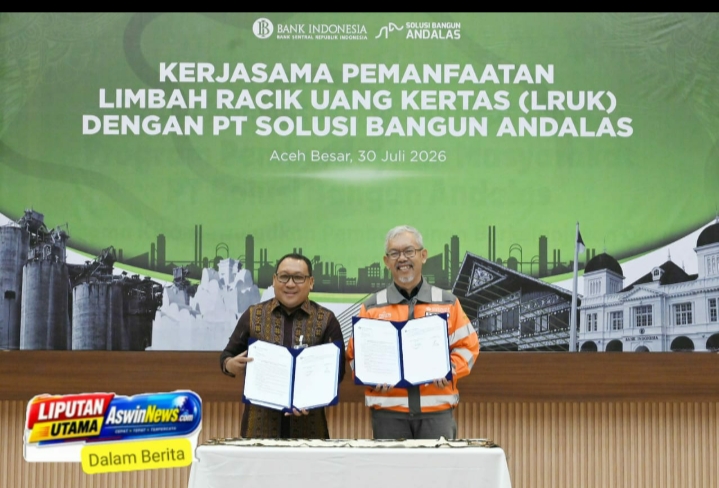
As an initial step in the partnership, Bank Indonesia Aceh handed over approximately five tons of LRUK to PT Solusi Bangun Andalas through its waste management unit, Nathabumi. The handover ceremony took place at Andalas Hall, Lhoknga, on Thursday (July 30, 2026), with Agus Chusaini, Head of Bank Indonesia Representative Office of Aceh Province, officially presenting the material to R. Adi Santosa, General Manager of PT Solusi Bangun Andalas.
R. Adi Santosa stated that the use of LRUK demonstrates how waste, often regarded as worthless, can be transformed into a valuable environmental resource while supporting the transition toward a circular economy.
“This collaboration with Bank Indonesia shows that waste management challenges can be turned into real environmental opportunities. By utilizing shredded banknote waste as an alternative fuel, we are not only promoting responsible waste management but also strengthening the circular economy, reducing fossil fuel consumption, and advancing a lower-emission cement industry,” he said.
Meanwhile, Agus Chusaini explained that the partnership reflects Bank Indonesia’s commitment to ensuring that unfit Rupiah banknotes are managed in a secure, accountable, and sustainable manner.
According to him, the utilization of LRUK adds value to the destroyed banknotes by converting them into an alternative energy source that supports sustainable development.
LRUK consists of shredded Indonesian Rupiah banknotes that are worn out, damaged, defective, or withdrawn from circulation by Bank Indonesia. At PT Solusi Bangun Andalas’ cement plant, the waste is processed using co-processing technology in cement kilns operating at temperatures of up to 1,500 degrees Celsius, allowing it to be fully utilized as fuel without leaving any residual waste.
Based on research conducted by the National Research and Innovation Agency (BRIN), LRUK has a calorific value of approximately 3,210 kcal per kilogram, making it suitable as an alternative fuel for the cement industry. Its utilization supports PT Solusi Bangun Indonesia Tbk’s waste-to-energy strategy while reinforcing the zero-waste principle in managing destroyed Rupiah banknotes.
This collaboration serves as an example of successful synergy between the financial and industrial sectors in creating innovative waste management solutions while contributing to Indonesia’s low-carbon development and circular economy initiatives.
Reporter: Drs. M. Isa Alima
Secretary of Aswin West Java: Abah Rohiman
Source: PT Solusi Bangun Andalas
Aswinnews.com – Reporting Facts, Enlightening the Nation.